Feather flag vs teardrop flag: which one sells better on site
Feather flags read further, teardrop flags look fuller. Compare wind behaviour, print area, pole pairing and freight cost — from a factory that moulds both.
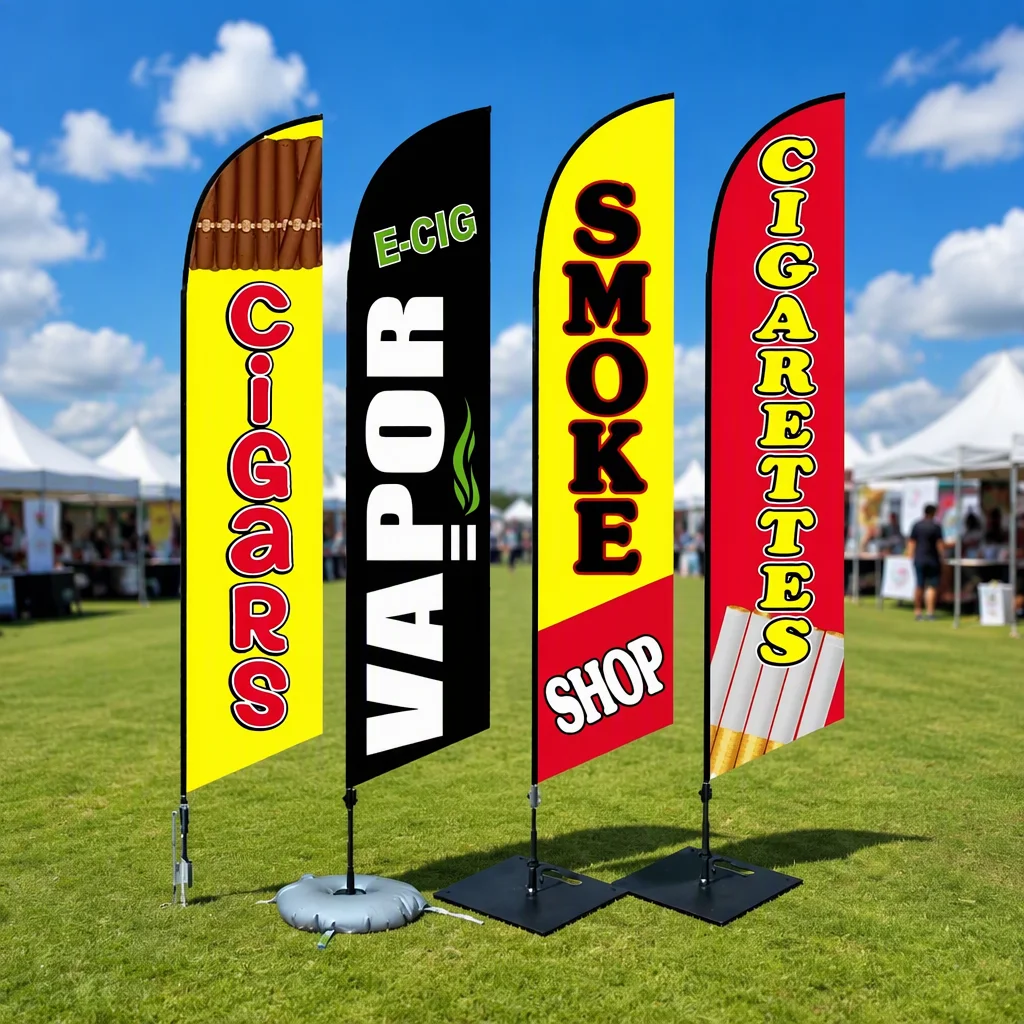
Short answer: if the flag has to be read from a road, a forecourt or across a car park, choose a feather flag — a tall narrow strip carries text further for the same amount of fabric. If the flag stands where people walk close to it — an event entrance, a shop front, a trade booth — a teardrop reads as the fuller, more finished shape. Most distributors stock both and split them by site type, not by price.
Feather and teardrop flags use the same pole hardware, the same 110 g or 130 g knitted polyester and the same dye-sublimation print. What changes is the silhouette, and the silhouette changes three things that matter commercially: how far the message carries, how the flag behaves in wind, and how much usable print area you get for your money.
The shape difference, without the marketing
A feather flag (also called a knife flag, because the trailing edge is concave like a blade) is tall and narrow. The printed face is a vertical strip: wide at the bottom, tapering to a point at the top. Height does the work.
A teardrop flag is wider and rounded, with a curved top and a straight vertical edge against the pole. It reads like a sail or a shield: more surface, less height, and a silhouette that looks deliberate from close range.
Side by side: what actually differs
| Criterion | Feather (knife) | Teardrop |
|---|---|---|
| Silhouette | Tall, narrow, concave trailing edge | Wide, rounded top, curved body |
| Reads best at | 40 – 120 m | 10 – 50 m |
| Print area | Less fabric, more vertical space | More fabric, more horizontal space |
| Wind behaviour | Flutters in light air, sheds gusts along the concave edge | Holds a fuller sail, more load on the pole and base |
| Artwork shape | Multi-line copy stacked vertically, logo on top | Horizontal lock-ups, product shots, big single word |
| Pole pairing | Same poles as teardrop | Same poles as feather |
| Base pressure | Lower sail area, so less ballast needed | Higher sail area, so more ballast needed |
| Where it wins | Roadside, forecourt, highway-facing sites | Events, entrances, indoor booths, shop fronts |
Which shape reads further?
Height beats width for a three-second read. A 4.5 m feather flag gives you roughly 70 × 340 cm of print in a vertical strip; the eye picks up the stack of words from far away because they sit one above another at head height and above.
A teardrop of the same pole length spreads that material sideways. It looks better at 15 m and worse at 80 m: from distance the wide body blurs into one shape and the small type disappears.
If your customer's site is a fuel station, a car dealership front line, a highway-facing lot or a plaza, feather is the safer recommendation. If the site is a shopping mall entrance, a conference booth, a hotel driveway or a shop door where people approach on foot, teardrop photographs better and looks more expensive than it is.
Wind behaviour: what fails first
Both shapes fail at the same place — the sleeve and the hem, not the print. Two practical rules from our line:
- Fabric weight matters more than shape. 110 g knitted polyester is the volume option for short campaigns; 130 g holds shape longer and resists print cracking on repeated folding. For windy coastal sites we quote 130 g as standard.
- A rotating spindle saves the sleeve. On a fixed base the flag twists around a stationary pole and chews through the sleeve within weeks. A 360° spindle — like the one on our T3 flat iron cross base — lets the whole flag turn with the wind, which is the single cheapest way to extend flag life.
A teardrop carries more sail area for the same pole length, so it loads the base harder. On exposed sites that means either more ballast or a shorter pole. See flag base types explained for the weight-to-pole-length pairing.
Print area and artwork
| Artwork job | Better shape | Why |
|---|---|---|
| 5 – 8 words of copy, read from the road | Feather | Vertical stack at consistent reading height |
| Logo + one product photo | Teardrop | Wide body holds a horizontal composition |
| Menu or price list | Feather | Long narrow columns of type |
| Brand pattern, no copy | Either | Silhouette does the work |
| Double-sided print | Teardrop | Wider panels block show-through more effectively |
Keep the logo in the top third on a feather flag. The lower half of the flag is what whips and folds in wind, so fine detail there is wasted; the top stays legible even in a stiff breeze.
Pole pairing and sizes
Both shapes run on the same 2.8 m, 3.4 m, 4.5 m and 5.6 m poles. The flag body is always about 10% shorter than the pole because the top sleeve and bottom pocket eat the difference.
| Pole | In feet | Feather flag | Teardrop flag | Sections |
|---|---|---|---|---|
| 2.8 m | 9 ft | 50 × 200 cm | 70 × 170 cm | 3 – 4 |
| 3.4 m | 11 ft | 60 × 240 cm | 90 × 200 cm | 4 |
| 4.5 m | 15 ft | 70 × 340 cm | 110 × 290 cm | 4 |
| 5.6 m | 18 ft | 80 × 410 cm | 130 × 350 cm | 5 |
The full size chart, including readable distance and container maths, is in our beach flag sizes guide. If you are still deciding on height, start with the pole length guide instead — getting the length wrong is the most expensive mistake in this category.
Cost and freight
Fabric is the cost driver, and a teardrop uses roughly 5 – 8% more of it than a feather flag on the same pole because the body is wider. On a 4.5 m set that is a small difference per unit; it only becomes visible at container level.
Freight is where the shapes converge. Both fold into the same export carton: our TX-FP45 4.5 m pole packs 35 poles per carton at 0.056 CBM and 22 kg gross, carton size 120 × 25 × 18.5 cm. One 20 ft container at roughly 28 CBM usable carries about 500 cartons — 17,500 poles — before weight becomes the limit. Flag bodies ship separately, folded, at far higher density.
What we actually ship most
- Feather 4.5 m — forecourts, dealerships, roadside, seasonal promotions. The default for distributors selling to retail chains.
- Teardrop 3.4 m — storefronts, events, exhibitions, hotels. The default for European retail and event hire.
- Feather 2.8 m and 3.4 m — sample kits, indoor booths, tight pavements.
A distributor's opening order is usually 60% feather, 40% teardrop, then adjusted after the first season once they see which site types their customers actually run.
Five mistakes that come back as complaints
- Teardrop on a highway-facing site. It looks good in the catalogue and disappears at 80 m.
- Feather with horizontal artwork. A wide logo squeezed into a vertical strip reads as noise.
- Text printed in the bottom third. That is the part that folds and wears first.
- A 5.6 m teardrop on a bare cross base. Sail area plus height plus no ballast equals a claim.
- No spare flag body per 10 poles. Bodies wear out before poles do; distributors who stock spares keep the account.
FAQ
Are feather and teardrop flags the same price?
At the same pole length and fabric weight they are within a few percent of each other. Teardrop uses slightly more fabric, so it usually quotes marginally higher. Fabric weight (110 g vs 130 g), print sides and pole material move the price far more than the shape does.
Which shape is better in strong wind?
Feather, generally — it has less sail area for the same pole length, so it loads the base and pole less. On exposed coastal sites, pair either shape with 130 g fabric, a rotating spindle base and more ballast, or drop one pole size.
Can I use the same pole for both shapes?
Yes. Poles are shared across the range; only the sleeve and pocket on the flag body change. That is why distributors can stock one pole SKU and two body SKUs.
Which prints better double-sided?
Teardrop. Its wider panels take a block-out layer more easily, so show-through is less visible under backlight. On a feather flag, double-sided print works but needs a heavier block-out and slightly longer lead time.
Which one should I recommend for a shop front?
Teardrop at 3.4 m for most shop fronts, because customers approach on foot and the rounder shape photographs better next to a door. Switch to feather when the shop sits behind a car park or faces a road.