Flag pole materials compared: fibreglass, aluminium and carbon
Fibreglass, aluminium and carbon flag poles compared: weight, stiffness, wind behaviour, finish, cost and which material fits which market — from the factory floor.
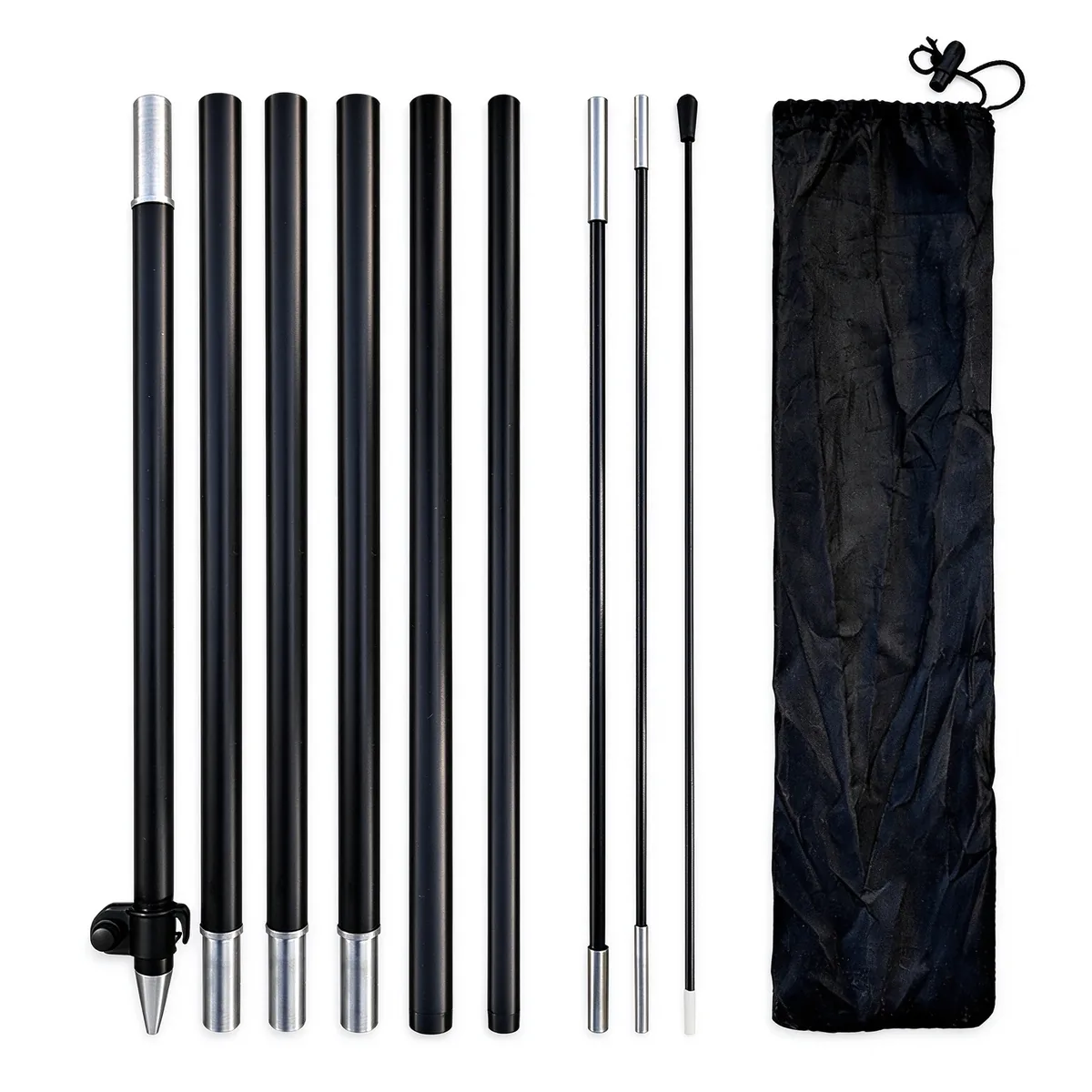
Short answer: fibreglass is the volume default — flexible, wind-friendly and economical. Aluminium is the stiff, straight, premium-finish option for forecourts and indoor use. Carbon is the lightest and stiffest, and only earns its price for premium retail and high-frequency event use. Same flag, same base — the pole changes how the whole set behaves.
The pole is the component buyers judge by feel: they pick it up, flex it, and decide whether the whole set feels cheap. Here is what each material actually does on site, not in a catalogue.
The three materials side by side
| Fibreglass | Aluminium | Carbon | |
|---|---|---|---|
| Weight feel | Light, whippy | Heavier, rigid | Lightest, very rigid |
| Wind behaviour | Flexes and recovers | Stands stiff, transmits load | Stiffest, smallest deflection |
| Failure mode | Tip fray, joint wear | Dents, bends at joints | Brittle crack on sharp impact |
| Finish | Black or white coating | Silver anodised, black optional | Matte black weave |
| Relative cost | 1× | ~1.5 – 2× | ~3 – 4× |
| Best for | Volume retail, events, giveaways | Forecourts, indoor, premium retail | High-frequency event hire, luxury |
Fibreglass: why it is the volume default
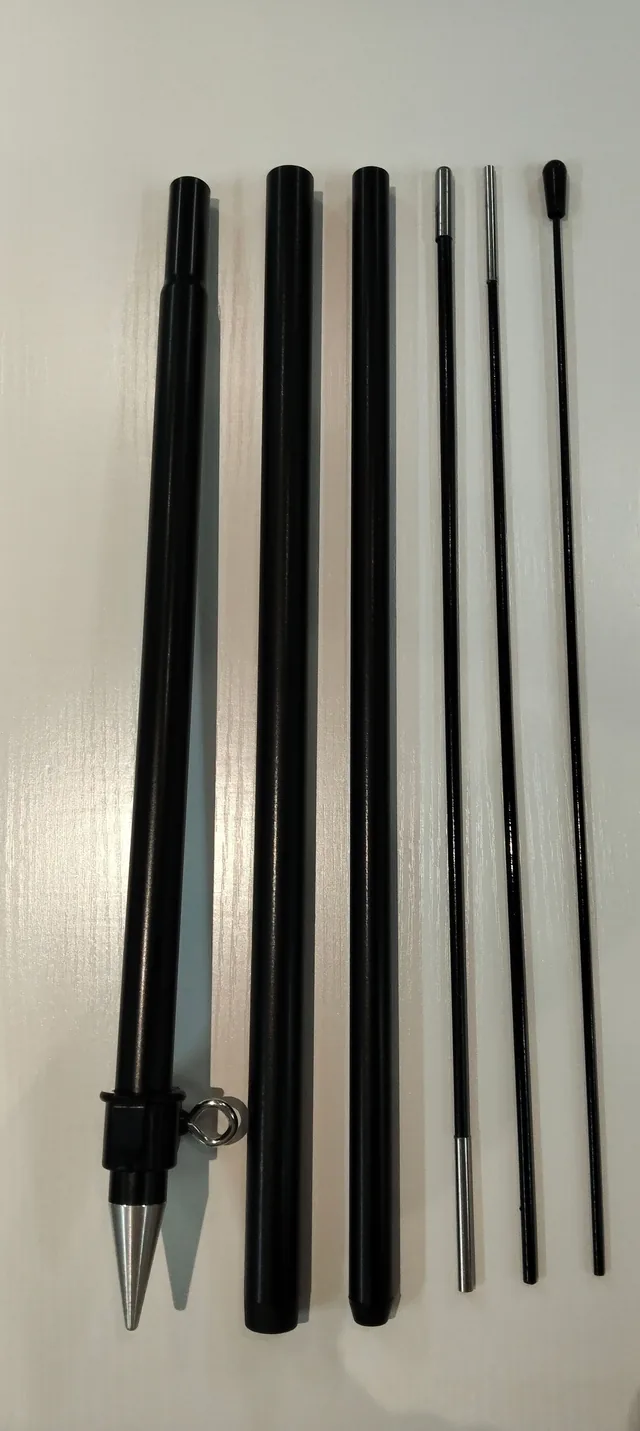
Fibreglass does the one thing a beach flag pole must do: take gust after gust and return straight. A rigid pole in a stiff wind transmits every load into the base; a fibreglass pole flexes, sheds the gust and comes back. That is why it dominates the roadside market — the material is doing shock absorption for the whole system.
Trade-offs: the coating wears at the ferrules after seasons of assembly, the tip can fray if stored unassembled in the bag, and it never looks "machined" the way aluminium does. For distributors stocking TX-FP45-class poles by the container, that cost-to-toughness ratio is exactly the point.
Aluminium: when straightness is the product
Aluminium reads as precision: perfectly straight sections, anodised silver or black, no flex at the tip. It is the pole for forecourts, dealerships and indoor installations — anywhere the set is photographed at close range or stands for months.
Trade-offs: it is heavier (which matters to whoever carries it), it dents rather than flexes, and every gust it does not absorb goes into the base — pair aluminium with a real tank, not a bare cross base, above 3.4 m. Our TX-WF150 wall flag kit uses an aluminium pole where the wall mount replaces the base entirely.
Carbon: the specialist
Carbon fibre wins on numbers: lightest, stiffest, fastest recovery. In practice it earns its price in two niches — event hire companies who carry poles daily and feel the weight saving in their backs, and premium retail where the pole is part of the brand's material story. For everyone else it is expensive insurance against a problem fibreglass does not have.
One handling note: carbon does not dent, it cracks. A sharp knock against concrete at the joint can end the section. Event crews who throw kit into vans should stay on fibreglass.
Sections, ferrules and the parts that actually fail
All three materials ship in sections because a one-piece 5.6 m pole cannot freight economically. What matters:
- Ferrule fit. A tight, long ferrule distributes load; a loose one wears and develops a wobble you can see from the ground.
- Joint placement. Joints must sit above the flag's bottom pocket, not inside it, or the sleeve catches on every rotation. The sizing logic is in the beach flag sizes chart.
- The topper. Ball or flat toppers are cosmetic — until they are not: a rounded topper sheds the flag bag better during packing.
Which material for which market
- US and EU volume distributors: fibreglass, 3.4 m and 4.5 m, black coating. This is 80% of what we ship.
- Forecourt and dealership programmes: aluminium, 4.5 m, silver anodised, with a filled square tank — see base pairing.
- Event hire and premium retail: carbon for 3.4 m and below, where weight savings compound across dozens of setups a month.
Care and storage, whichever you choose
- Store poles assembled-ish in the bag, tips down — loose tips fray.
- Wipe ferrules; grit in the joint is what wears coatings.
- Never leave poles standing on hot paving in full sun for weeks — coatings age faster than fabrics.
- Transport bases and poles separately; the base is what dents the pole in transit.
FAQ
Which flag pole material lasts longest?
Aluminium lasts longest as hardware — it does not fatigue the way composites can — but it dents. Fibreglass outlasts aluminium in wind-exposed outdoor service because flexing is not damage. Carbon is durable but impact-brittle.
Is a fibreglass flag pole strong enough for a 5.6 m flag?
Yes, in fibreglass that is a standard build — the 5.6 m pole is five sections and the material is chosen for exactly that flex regime. The weak link at 5.6 m is the base, not the pole.
Can I mix materials in one order?
Yes, poles are separate SKUs from flags and bases. Many distributors stock fibreglass for volume sizes and aluminium for the premium 4.5 m programme.
Why does my fibreglass pole look scratched after one season?
Ferrule wear, not failure. The coating scuffs where sections slide together; the fibre underneath is intact. If the joint still seats tight, the pole is doing its job.
Do carbon poles fit the same flags and bases?
Yes — poles, flag sleeves and base spindles are standardised across the range. Swapping material changes the feel, not the system.